Sokoban Minimal Moves: Plan Fewer Pushes and Restarts
Sokoban minimal moves play starts with a useful distinction: walking is often reversible, while pushing changes the board. To solve a level with fewer pushes, plan the final approach to each goal, keep the required standing squares open, and treat a restart as information when a push has made the route impossible.
This guide focuses on practical push reduction rather than a promise that every board has one obvious perfect line. You will learn how to separate push count from walking distance, assign boxes to goals, test a route before committing, and use a solver as a verification tool. The same habits transfer to Sokoban-style games such as Zeek the Geek, even when their objects and goals are different.
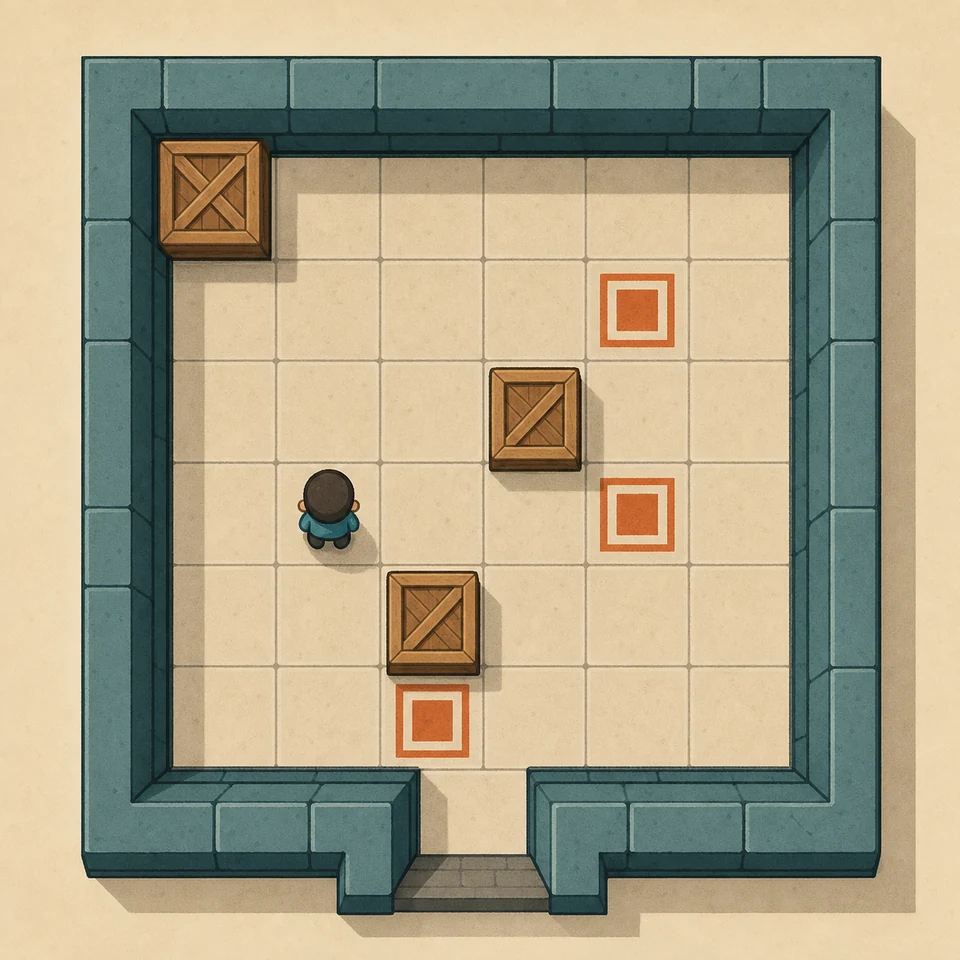
A low-push solution begins by protecting the squares needed for the final approach, not by chasing the nearest target.
What does minimal moves mean in Sokoban?
Players use "minimal moves" in two related ways. A push-optimal solution uses the fewest box pushes, while a move-optimal solution also reduces the character's walking steps. Those goals can disagree. A wide loop may add twenty walking steps but save one irreversible push; taking the shortcut may force a box into a bad corner and require a restart.
Unless a game clearly defines a score, start with pushes. Each push changes which squares are occupied, which corridors remain open, and which side of a box the player can reach. Walking can usually be repeated after a mistake, but a push may remove the only future approach. This is why a calm player who walks farther can finish with a cleaner solution than a player who rushes toward the goal.
Separate walking moves from pushing moves
Keep two counts while testing a board. The first is the number of pushes. The second is the walking distance between pushes. The push count tells you whether the board state is improving; the walking count tells you whether the route around the room is efficient. Recording both prevents a common mistake: rejecting a safe route just because the player takes a long way around a box.
| Action | What changes | How to treat it |
|---|---|---|
| Walk to an open square | The player position | Use the safest route; extra steps are often harmless. |
| Push a box one square | The permanent board shape | Count it, check access, and pause before the next push. |
| Restart the level | Returns to the known state | Use it after a proven deadlock instead of adding random pushes. |
| Fill a goal | A goal and its surrounding space | Verify that the solved box will not block another approach. |
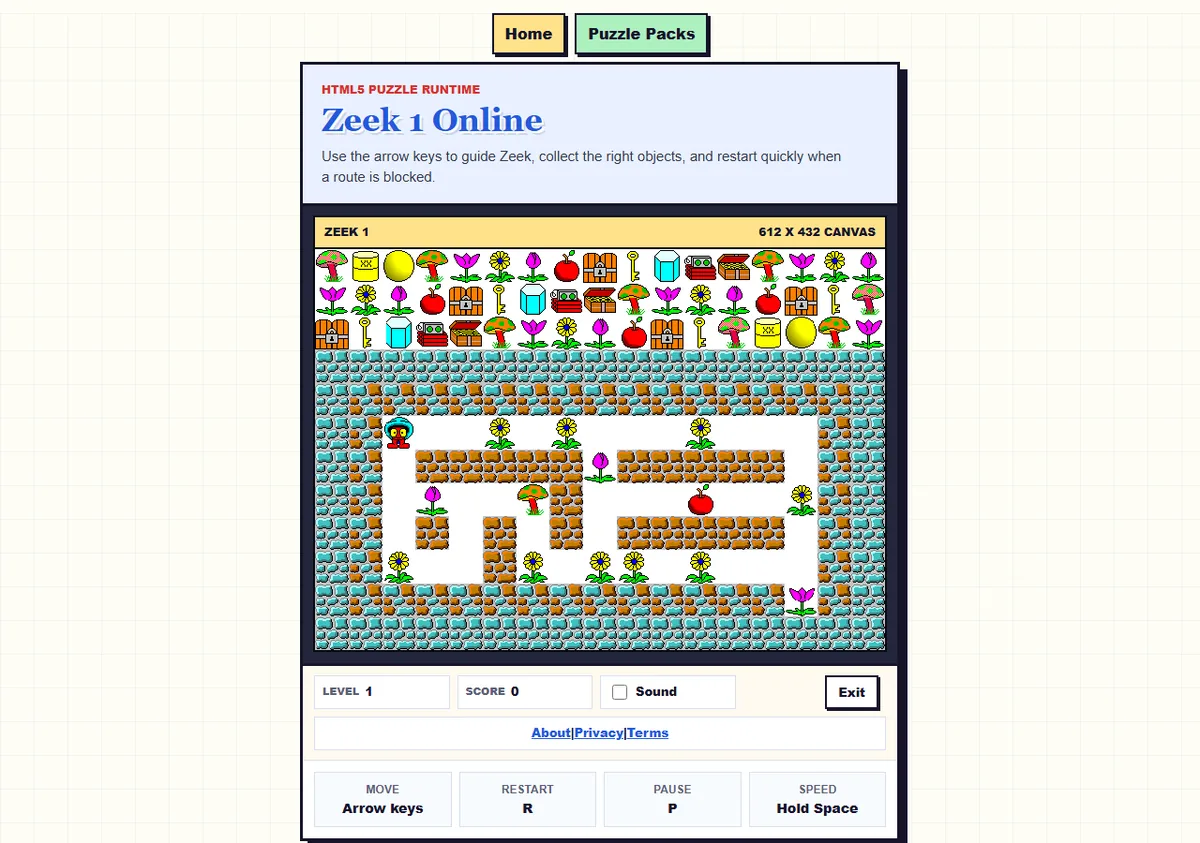
This real Zeek board is not a classic Sokoban level, but it shows the same planning question: which spaces must stay reachable after an irreversible action?
Plan the final push backward
The most reliable way to reduce pushes is to plan from a goal backward. Pick the goal with the fewest approach directions. Imagine the box in the goal and ask where it stood one push earlier. Then mark the square where the player had to stand. Repeat the chain until you reach a starting position you can actually walk to.
- Choose a constrained goal. A wall goal, pocket, or end of a corridor usually has fewer valid final directions.
- Mark the approach square. The box needs a free square immediately before the final push.
- Mark the standing square. The player must reach the opposite side without crossing a blocked lane.
- Reserve the route. Do not fill a nearby goal or park a second box on a square in the backward chain.
- Execute one safe push. After it, re-check the chain instead of assuming the next push is still valid.
Destination free? Next standing square free? Another box still reachable?
Can the player change sides? Is the corridor open? Did a goal become a wall?
Which direction is the final approach? Can the box leave the wall if needed?
Which box must pass deepest? Which box can wait in open space?
Assign boxes to goals before moving them
Fewer pushes usually comes from choosing the right box for each goal, not from moving every box cleverly. A flexible box can reach several targets, while a restricted box may have only one usable lane. Spend the restricted option first and keep the flexible option uncommitted. This is the Sokoban version of saving a scarce resource.
| Board clue | Safer assignment | Why it reduces pushes |
|---|---|---|
| One goal is at the end of a one-cell lane | Send the box that can enter that lane cleanly. | A wrong box may need to be backed out, if backing out is possible at all. |
| Two boxes share a corridor | Move the box for the deeper goal first. | The nearer box can otherwise become a stopper. |
| A box has two open approaches | Keep it as the flexible assignment. | It can fill whichever goal remains after the restricted box is placed. |
| A goal sits in the workspace | Delay it until traffic is finished. | A solved box still occupies a turning or standing square. |
Use a push-count checkpoint after every commitment
After each important push, pause for a short checkpoint. Count the remaining boxes and goals, list the open approach directions, and confirm that the player can still reach the next standing square. If any answer is no, restart immediately. A restart costs time but does not add pushes to the finished solution; continuing a dead position only creates noise.
Keep a best-known record such as "14 pushes, two restarts." When you find a route with the same push count, prefer the one with a safer state and fewer uncertain assumptions. Only optimize walking after the push count stops improving. This order keeps you from polishing a route that still has a hidden deadlock.
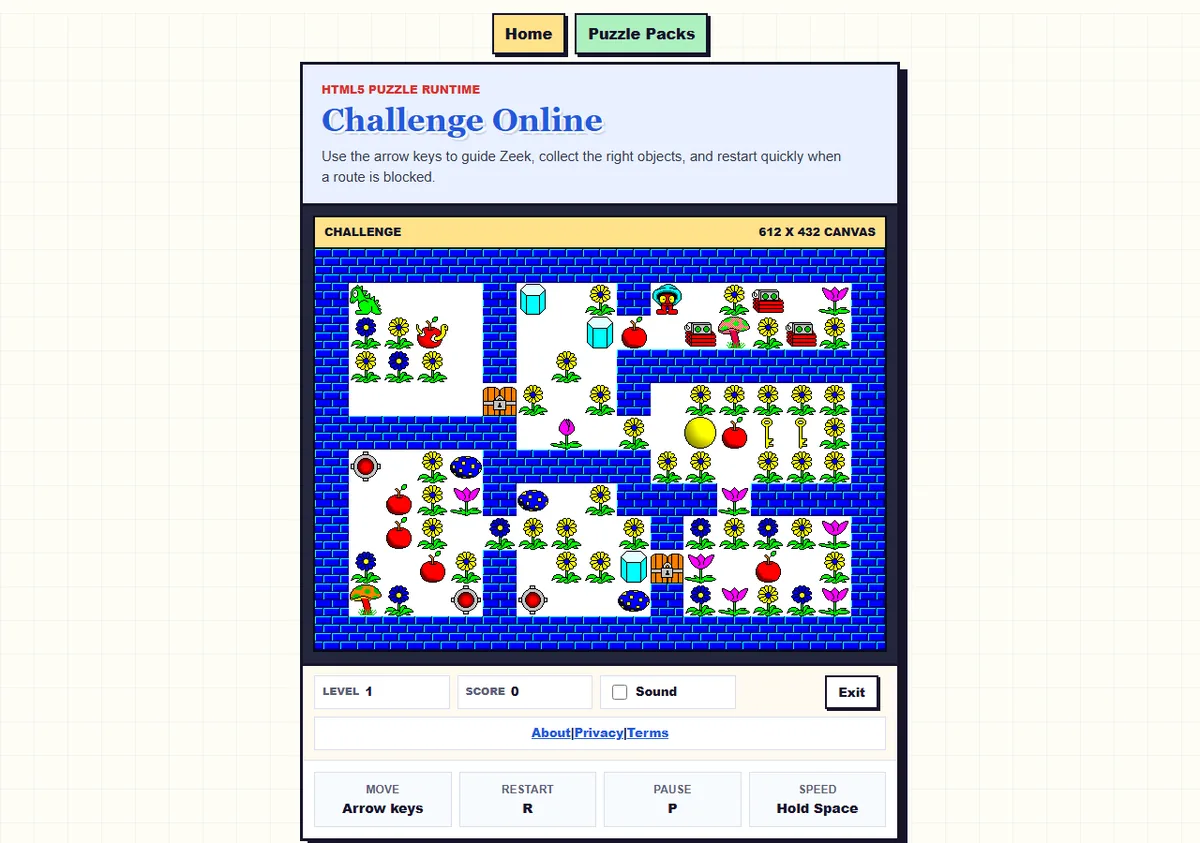
A dense board makes the checkpoint visible: after one object moves, the useful question is whether the next standing square is still reachable.
A small-board thought experiment
Imagine two boxes and two goals in a narrow room. The left box can reach either goal, but the right box can reach only the far goal because a wall blocks its other approach. The near goal is tempting. Pushing the left box onto it may take one push, yet it can seal the lane needed by the right box. The lower-push plan is to move the restricted right box first, even if the player walks around the room to reach its standing square. The flexible left box then finishes the open goal.
Now imagine that the far goal is already filled, but the player cannot reach the side of the left box needed to finish. That is an access deadlock, not a distance problem. Undo the last useful-looking push, reopen the loop, and approach the box from the other side. The solution may use the same number of pushes as before, but it avoids a restart and preserves the future route.
Use a Sokoban solver as a check, not a shortcut
A solver is helpful when you want to check whether a small ASCII board is solvable or compare a hand plan with a machine-found route. Read its limits first. A bounded search may stop at a size or visited-state limit, and a returned move string may optimize pushes, walking, or neither depending on its implementation. Treat an unsolved search window as "not proven," not as proof that the board has no solution.
The site's Sokoban solver is designed for small boards. Use it after you have marked goals and likely assignments. If the solver finds a route with fewer pushes, compare the first different commitment: that is usually the lesson worth carrying to the next puzzle.
How the minimal-moves idea applies to Zeek the Geek
Zeek the Geek is not a pure Sokoban game. Its keys, doors, hazards, collectibles, and other objects can change a route in ways that classic crates do not. Still, the push-count mindset transfers: protect future access, identify irreversible interactions, and avoid spending a scarce object before you know its role. If a board becomes impossible, restart early and change one commitment rather than adding random movement.
For broader board-reading fundamentals, see the Sokoban levels guide and Sokoban strategy tips. To practice the habit, open a Zeek puzzle pack, record your pushes, and compare the board state after each commitment.
Sokoban minimal moves FAQ
What does minimal moves mean in Sokoban?
It usually means completing the level with as few irreversible pushes as practical. Some games also score walking steps, so check the game's stated rule before calling a route optimal.
How do I solve Sokoban with fewer pushes?
Plan backward from constrained goals, assign boxes before moving them, protect standing squares, and restart when a push creates a proven deadlock.
Should I count walking moves or pushes?
Count pushes first because they change the board. Track walking after the push sequence is safe; a longer walk can be better than an extra push.
Is the fewest-push solution always the shortest solution?
No. Push-optimal and move-optimal are different goals. A route can use fewer pushes but require more walking around the room.
Can a Sokoban solver find minimal moves?
A solver can search for a route on a small board, but its limits and scoring rule matter. Use it to test a hypothesis and study the push order rather than copying a string blindly.
When should I restart a Sokoban level?
Restart when a non-goal corner is occupied, a shared corridor is sealed, or the player cannot reach the next required standing square. Early restarts protect your best push count.
Reference notes
This guide separates practical push reduction from a proof of mathematical optimality. The classic rules and level-planning vocabulary were checked against the official Sokoban reference and Sokobano level-format notes.
Test a lower-push route
Open a compact Zeek pack, protect the next standing square, and write down your push count before trying to shorten the walk.
Play Zeek online Check a small board