What Is Sokoban? Meaning, Rules, Deadlocks & Zeek
What is Sokoban? The name means “warehouse keeper” in Japanese. It is a box-pushing puzzle in which the player walks through a compact room and pushes crates onto goal squares. The rule sounds simple, but every push changes the future shape of the board: crates usually cannot be pulled, so a box placed in the wrong corner can make the level impossible.
Zeek the Geek is not a pure Sokoban conversion, yet it belongs to the same family of deliberate, grid-based puzzles. Zeek adds apples, boulders, keys, doors, flowers, monsters, mushrooms, hazards, and route-dependent interactions. Understanding Sokoban makes it easier to see why a Zeek level can fail several moves before the mistake becomes obvious.
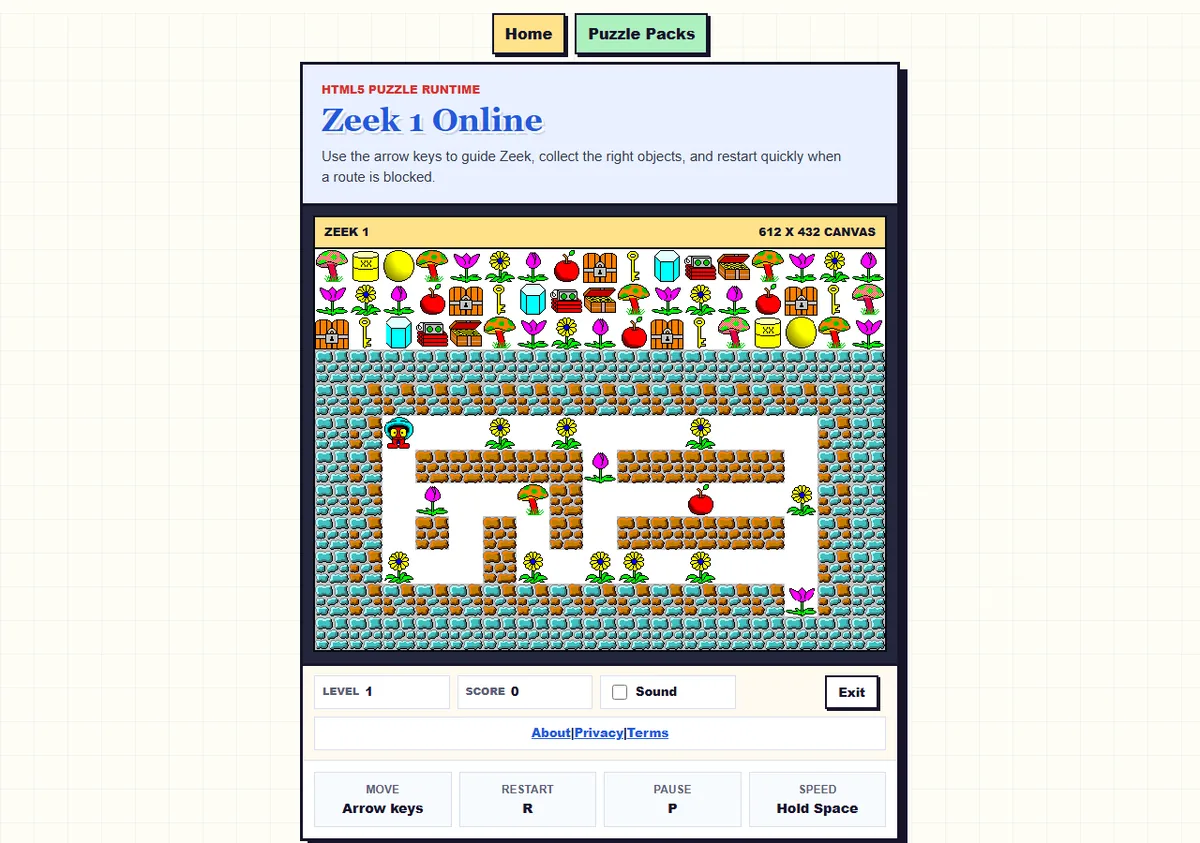
Real gameplay capture from this site's browser version; not an official commercial screenshot.
What does Sokoban mean?
The Japanese word 倉庫番 is commonly translated as warehouse keeper. In the original puzzle idea, the keeper must move boxes through a warehouse and place every box on a marked storage location. The player can walk into open floor and push one adjacent box when the square behind it is empty. The player cannot normally pull a box, jump over it, or push two boxes at once. That one-way action is the source of the genre’s difficulty.
The five rules that define a Sokoban puzzle
Most versions vary in graphics and controls, but the logical contract stays stable. A good solution is not simply a shortest walking path; it is an order of pushes that preserves access to every remaining box and goal. Walking can often be undone, while a push may remove the only route to the side of a box needed later.
| Rule | What it means | Why it matters |
|---|---|---|
| Walk | Move through empty floor | Walking is usually reversible |
| Push | Move one box into one empty square | A push changes the puzzle state |
| No pulling | A box cannot be dragged back | Bad corners become permanent |
| Goals | Place every box on a target | A filled goal can still block another route |
| Reset | Restart after a deadlock | Recognition is faster than random recovery |
Why deadlocks matter more than distance
A deadlock is a position from which the puzzle cannot be completed even though the player can still move. The easiest example is pushing a box into a non-goal corner. More subtle deadlocks happen when two boxes block a corridor, when a goal is filled too early, or when the player loses access to the side needed for the next push. Expert play therefore asks where the character must stand after a push, not only where the box should go.
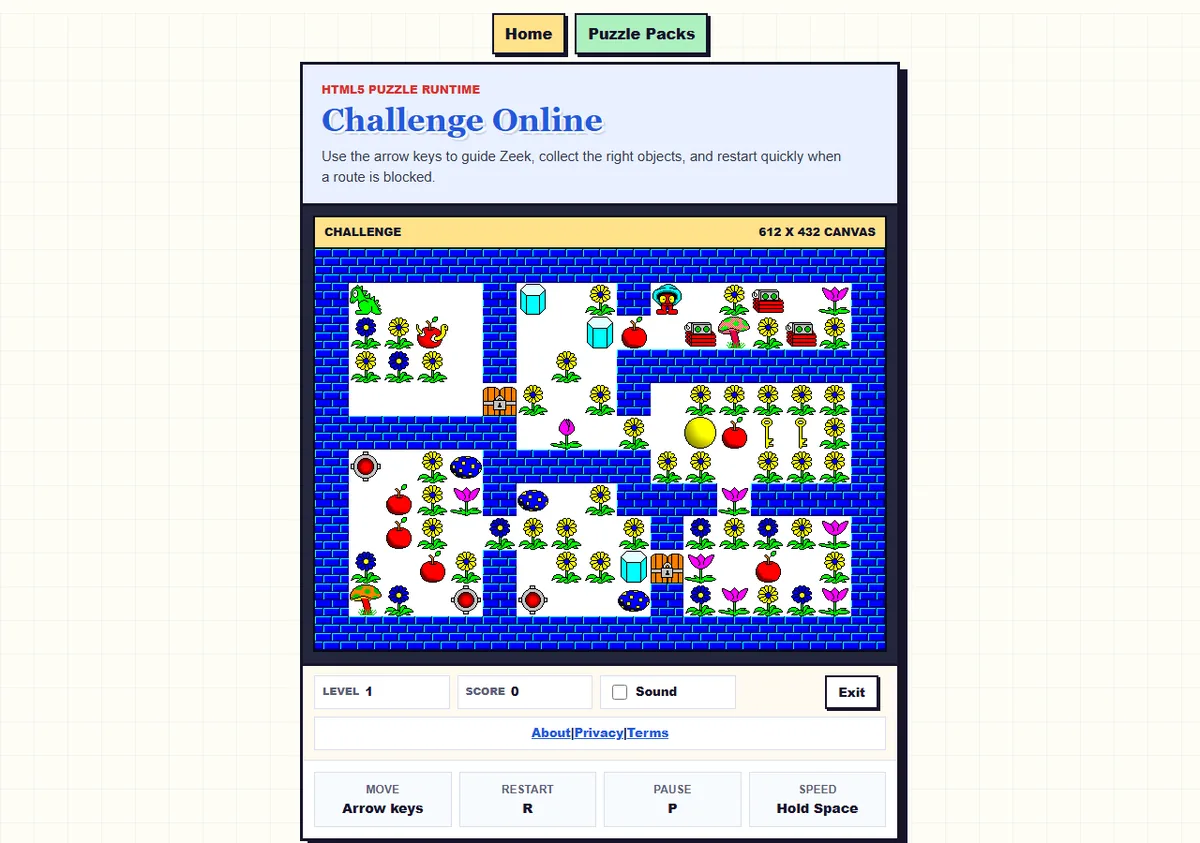
A compact board rewards planning around access squares before moving objects.
How Zeek the Geek differs from pure Sokoban
Zeek borrows the tension of irreversible object movement, but its objective is broader than parking identical crates. Apples, boulders, keys, doors, flowers, monsters, and terrain can interact in different ways, while collecting mushrooms and reaching a safe route may determine success. Some objects are tools, some are barriers, and some change danger elsewhere on the board. The result feels like Sokoban mixed with an adventure-puzzle vocabulary.
This difference explains why a standard Sokoban habit can be necessary but insufficient. Preserving space and avoiding corners still matters, yet Zeek also asks the player to sequence keys, hazards, enemies, and collectibles. A move that looks harmless geometrically may spend an object needed for a later interaction, close a route, or remove the standing square required for the final move.
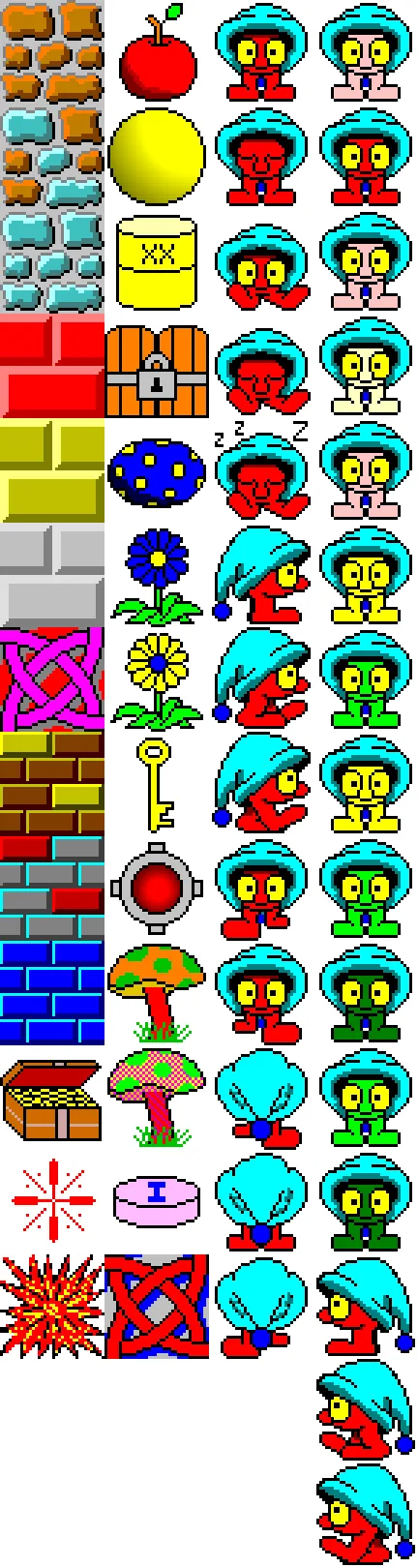
Different Zeek objects create Sokoban-like deadlocks plus extra interaction rules.
A practical way to solve box-pushing levels
First, mark every goal, bottleneck, corner, door, hazard, and movable object. Second, work backward from the final positions: identify the last push into each goal or the last interaction that opens the exit. Third, protect access squares—the places where the character must stand to make those final moves. Fourth, test pushes in an order that keeps the widest number of routes open. Finally, reset early when an object enters a proven dead square. Restarting is part of solving, not a failure.
Sokoban terms that help with Zeek walkthroughs
Useful terms include dead square, corridor, bottleneck, push order, access square, goal room, and freeze deadlock. Using those ideas makes walkthrough instructions more precise. Instead of saying move the rock left, a guide can explain that the left push preserves the lower access square and prevents a corner deadlock. That language also helps players compare Zeek with Chip’s Challenge, classic warehouse puzzles, and modern box-pushing games without pretending the games are identical.
FAQ
Is Zeek the Geek a Sokoban game?
Zeek is Sokoban-like rather than a pure Sokoban game. It uses grid movement and irreversible object placement, but adds collectibles, keys, doors, monsters, hazards, and several object behaviors beyond pushing identical crates onto goals.
What is the Sokoban meaning in English?
Sokoban is commonly translated from Japanese as warehouse keeper. The name describes the player’s job of moving boxes through a warehouse and placing them on storage goals.
Why can’t Sokoban boxes be pulled?
The no-pulling rule makes pushes consequential. It creates deadlocks, forces planning, and separates the puzzle from simple pathfinding.
What should a beginner check before pushing?
Check the destination square, the player’s next standing position, nearby corners, corridor width, remaining goals, and whether another box or object will still be reachable.
Can I play Zeek online instead of downloading it?
Yes. This site provides a browser-based fan version and does not offer an installer, APK, version file, or safety-scan claim.
Sources checked
Try the ideas in a real Zeek board
Play a level slowly, identify irreversible pushes, and protect the squares Zeek will need later.
Play Zeek online