Sokoban Levels: How to Read, Choose, and Solve Box-Pushing Boards
Sokoban levels are easiest to solve when you treat them as a sequence of future positions, not a race to the nearest goal. Mark the walls, corners, goals, and standing squares first. Then choose a goal order that keeps the remaining routes open.
This guide explains a repeatable way to read Sokoban levels, recognize deadlocks, plan backward from the final push, and decide when a restart is smarter than forcing a damaged position. It works for classic box-pushing puzzles and for related games such as Zeek the Geek, although Zeek adds keys, doors, hazards, and other objects. For the historical boundary between the original Sokoban and modern variants, see the companion guide.
Planning a difficult board? Compare tight routes and irreversible pushes in the hardest Sokoban levels guide.
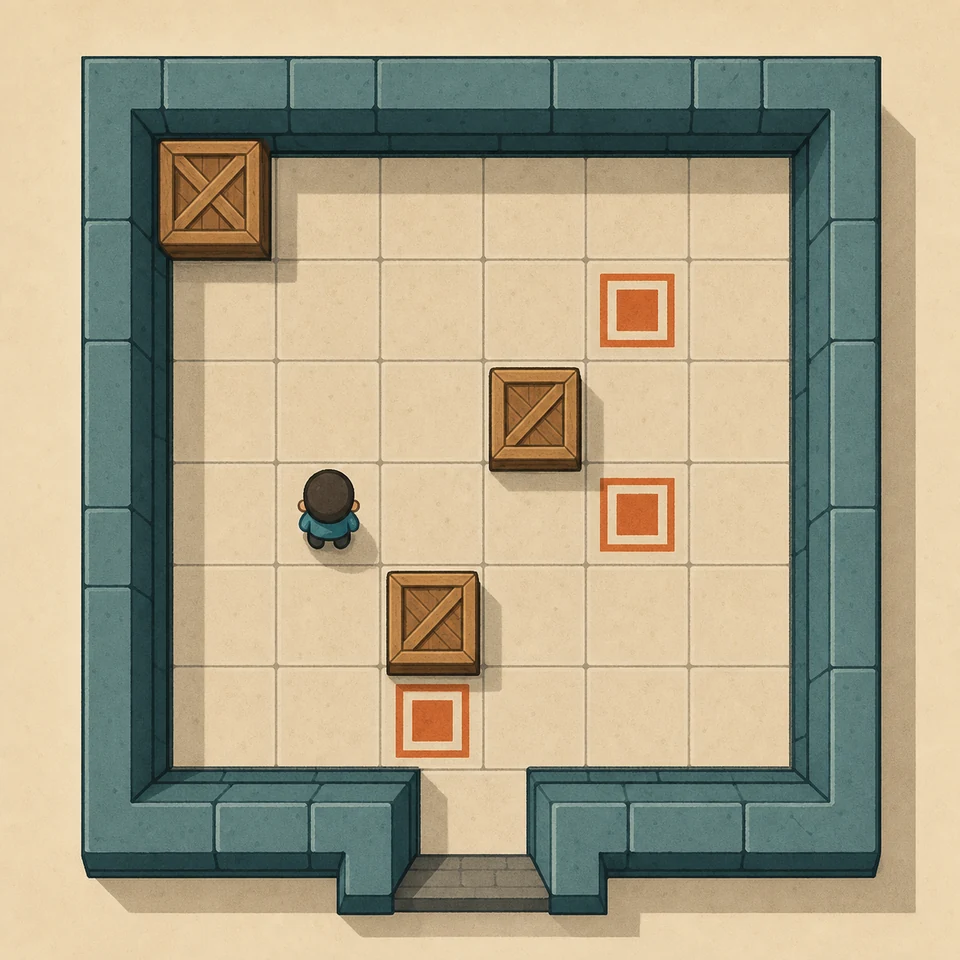
Concept illustration: the important question is not which crate is closest, but which future pushes remain possible.
Read the board before the first push
The first pass should be observation, not movement. Count the boxes and goals, identify the walkable area, and look for spaces that can be entered from only one direction. A level may look open because the player can walk around, while the boxes are already constrained by walls and approach angles.
Use this checklist before touching a crate:
| Board feature | Why it matters | Question to ask |
|---|---|---|
| Non-goal corner | A box pushed there normally cannot leave. | Can any box enter this corner safely? |
| One-cell corridor | A box may move only forward or backward. | Which box must pass through first? |
| Wall goal | The final approach direction may be fixed. | Where must the player stand for the last push? |
| Standing square | The player needs an empty square behind each push. | Will another box occupy that square too early? |
| Open loop | Walking routes let you change sides. | Which push would close this loop? |
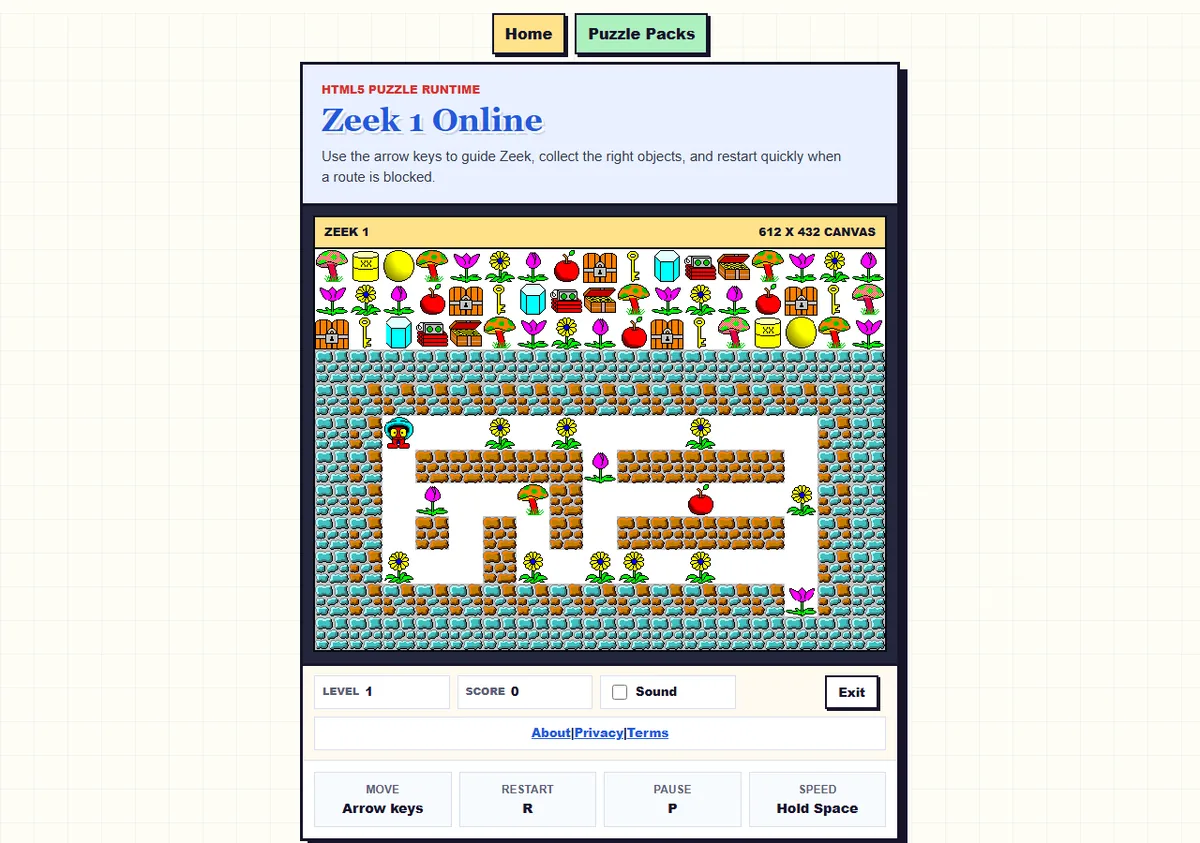
Real gameplay capture from this site's browser version. It is not a classic Sokoban board, but it shows why future access matters before an irreversible move.
Do not confuse walking distance with solving difficulty. A box may be one square from a goal and still be unusable if the player cannot reach the correct side. Conversely, a box that seems far away may be the correct first choice because its route is the one most likely to disappear.
Choose the goal order before moving a box
Most failed Sokoban levels are not lost because the player cannot push a box. They are lost because the player pushes a box into a useful lane before deciding which box needs that lane. Goal order is therefore a route decision.
A reliable priority is:
- Reserve goals with only one practical approach.
- Handle boxes that must travel through a narrow corridor.
- Place a box on a wall goal only after checking whether the wall is still needed as a transport lane.
- Leave flexible center spaces open until the constrained boxes are settled.
- Finish easy, reversible placements last when they do not block a standing square.
| Situation | Usually safer | Common mistake |
|---|---|---|
| Two boxes share one lane | Send the farther or less flexible box first. | Parking the nearer box where it blocks the lane. |
| Goal beside a wall | Plan the final approach before pushing. | Filling the goal from a direction that leaves no access. |
| Several open goals | Keep the central turning area clear. | Solving the visually closest goal because it feels efficient. |
| Box beside a corner | Confirm that the corner is a goal or a temporary stop. | Assuming every empty corner is harmless. |
Solve from the final push backward
When a level feels confusing, stop looking at the first move. Choose one goal and imagine the last push that would place a box there. The square behind the box is the player's final standing square. Now ask how the box and player can reach those two squares without sealing the rest of the board.
- Pick a goal that has few approach directions.
- Mark the square where the box must stand immediately before the final push.
- Mark the square where the player must stand for that push.
- Plan the previous box position and the player's route to it.
- Repeat until the chain reaches a starting position, then execute only the first safe step.
This reverse-planning method is more useful than counting moves. It tells you which spaces must remain empty and which order is forced. If the backward chain asks the player to stand on a wall, enter an occupied corner, or pull a box, the chosen goal order is wrong even if the board looks close to solved.
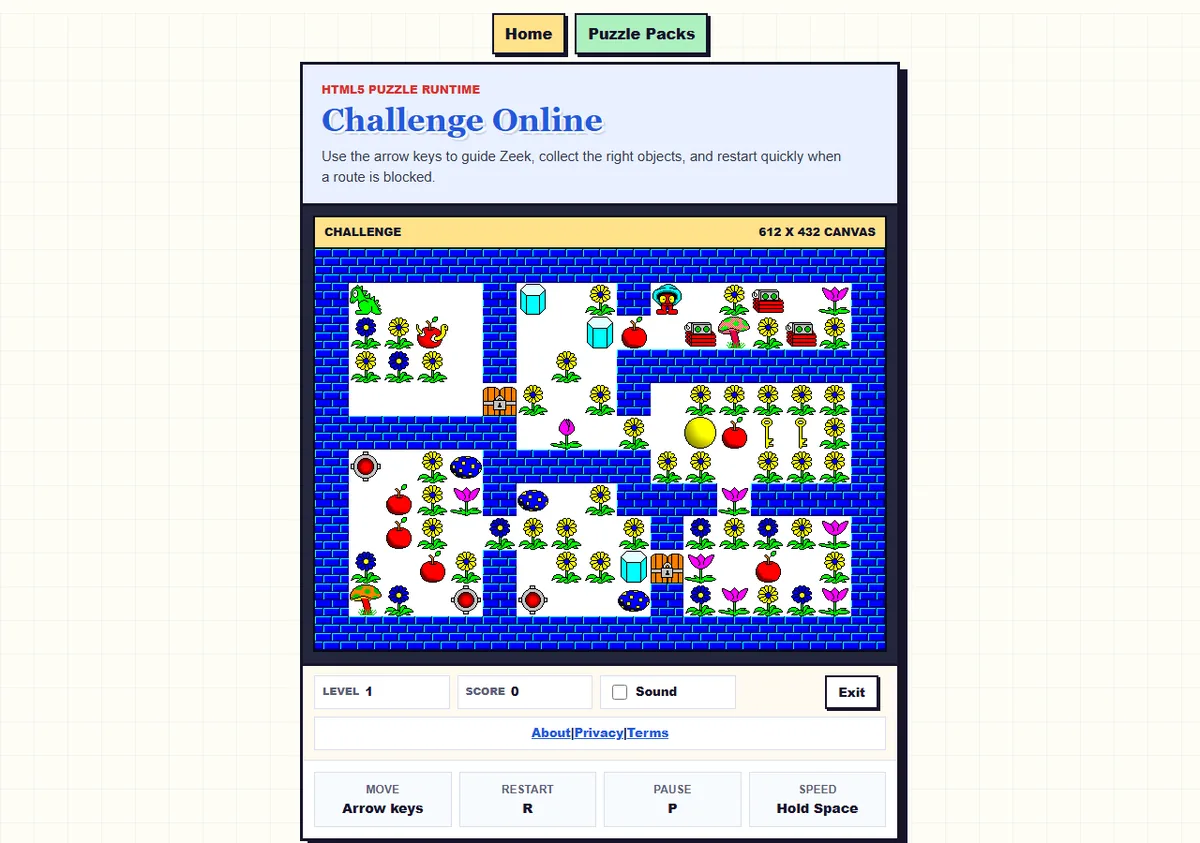
A real Challenge board from this site. The same habit applies: identify the required final access square before committing to a route.
Recognize Sokoban deadlocks early
A Sokoban deadlock is a position that cannot lead to a completed level, even when the player can still walk. The classic example is a box in a non-goal corner, but difficult levels use less obvious deadlocks that preserve movement while removing the needed future push.
- Corner deadlock: a box is against two walls and the square is not a goal.
- Wall deadlock: a box is trapped along a wall with no goal reachable on that wall segment.
- Two-box freeze: two boxes block each other or fill a corridor before both destinations are ready.
- Access deadlock: the box can still move, but the player can no longer reach the side needed for the next push.
- Goal-order deadlock: a box is correctly placed on a goal, but that goal occupies the only route to another goal.
After every important push, pause for a ten-second audit: which boxes can still move, which goals remain, and can the player still reach both sides of the active lane? This small check catches many failures before they become long, irreversible sequences.
Use a four-step solving method
For a new level, repeat the same four passes. The method keeps experimentation useful without turning the puzzle into random pushing.
Keep a short note when a level is unusually dense: “box A needs the top lane,” “goal B must be last,” or “do not occupy the center.” You do not need a full move list. A few constraints preserve the important reasoning while leaving room to discover the route yourself.
Know when to restart or use a walkthrough
Restarting is part of solving, not a punishment. Restart when a non-goal corner is occupied, when a one-cell corridor is sealed, when the final goal has no usable approach, or when you have lost the standing square required for the next push. Continuing after one of these signals usually adds walking but no progress.
A walkthrough is most helpful after you have identified the decision that confused you. Compare the next constraint or goal order rather than copying every arrow. That keeps the explanation useful and lets you transfer the idea to another level. The site's Zeek walkthrough follows this spoiler-light approach for Part One levels.
How the method applies to Zeek the Geek
Zeek the Geek is not a pure Sokoban game: its objects do not all behave like identical crates, and keys, doors, hazards, flowers, enemies, and route-dependent interactions can change the board. Still, the central discipline is shared. Before moving an object, ask which squares and interactions must remain available later.
For a classic rules explanation, read what Sokoban means and how deadlocks work. For Zeek-specific board construction, use the level editor guide. When you want to test the idea, play a Zeek puzzle pack online and inspect the board before the first irreversible action.
The feature illustration above is a conceptual editorial graphic, not a screenshot. The two body images are real captures from this site's browser implementation and are labeled as such.
Try the Sokoban solver with a small ASCII board.
Sokoban levels FAQ
How should I start a Sokoban level?
Do not push the nearest box immediately. Mark corners, goals, one-cell corridors, and the standing squares needed for future pushes before choosing an order.
What is a Sokoban deadlock?
A deadlock is a board position that cannot lead to a completed level, such as a box in a non-goal corner or two boxes sealing the only route.
Should I solve the closest goal first?
Not always. Solve the goal that is hardest to reach or most likely to become blocked, while keeping the remaining standing squares and corridors open.
When should I restart a Sokoban level?
Restart when a box has lost its needed approach direction, a corridor is sealed, or the final goal can no longer be reached without pulling a box.
Can these ideas help with Zeek the Geek?
Yes. Zeek is not pure Sokoban, but reading future access, protecting routes, and planning irreversible object moves are useful in both games.
Reference notes
The rule and level-planning discussion was checked against established Sokoban references. This page is an editorial solving guide, not a claim that every level has one unique shortest solution.
Ready to test a route?
Open a Zeek pack, inspect the board, protect the next standing square, and restart early when a push closes the only useful lane.
Play Zeek online